
FAMILY / CHESS
Why We Picked Chess
My son started learning chess when he was about six, simply because it was one of the activities offered at his after-school Chinese class. We’ve stuck with it because I think there’s a lot to learn from this ancient, seemingly “figured-out” game.
Now, I’m not a good chess player myself. My son isn’t a prodigy by any means, but within a few months, he was beating me regularly. I took it in stride. It was an obvious way to show him that Daddy isn’t great at everything, and that’s OK; that being older doesn’t automatically make you better at something; and that you can improve with intentional practice.
I see chess as a simplified version of life. At least everyone has to follow the same rules. It’s a good place for a child to see how one decision affects the next. Sometimes you have two good moves, but the order matters. Sometimes you have to deal with a threat before you can get back to your own plan. And even when you’re down a few pieces, you can still play to your strengths and threaten checkmate.
Chess also gives him a safe way to take risks and learn how to lose. You can give up a piece now for a better position later, but sometimes the sacrifice doesn’t pay off. And if you make a blunder, you still have to decide what to do with the position in front of you. Sometimes it’s worth playing on. Sometimes it’s time to accept the loss, see what you can learn from it, and start another game. There’s something to learn from the wins, too.
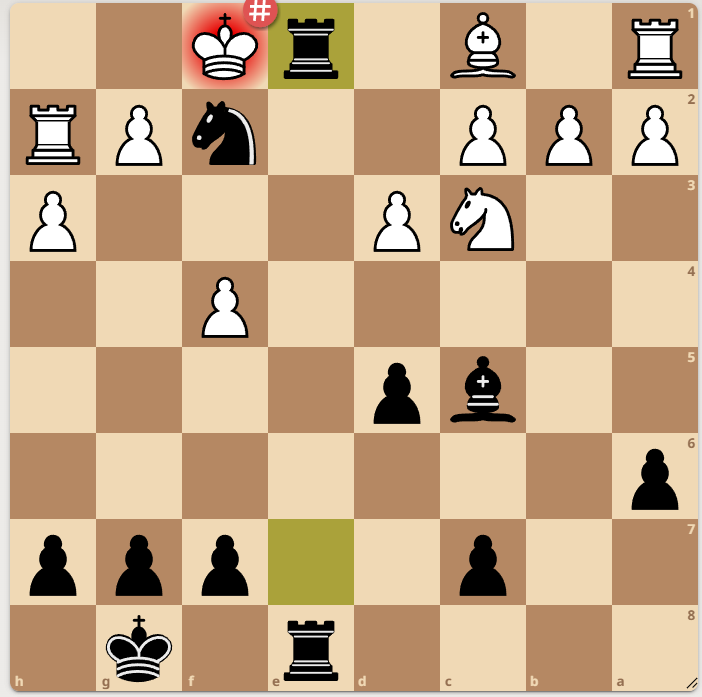
Then there’s the challenge of playing in front of someone. My son plays much better online than in person. When I asked him why, he said, “Because they can see me!” We hope to try a few small tournaments so he can meet other kids who play and get a little more comfortable with those nerves.
In the meantime, we’ve figured out how to fit Chess.com and Lichess into his screen time, and we’ve checked out chess books from the library. We also do goofy things like play for the title of “chess champion of the house.” So far, it’s just the two of us, though one of his missions is to teach Mommy and his little sister how to play.
It’s gratifying to see him work through something difficult and get better at it. I’m also getting a better sense of when to step back and let him learn from his mistakes, when to offer my often questionable advice, and when he just needs some encouragement. I want him to notice his own progress, even when it doesn’t show up as a win or a higher rating.
He’s usually the chess champion of the house now, though his old man can still get him once in a while. One unexpected benefit of all this is that I’ve gotten slightly better at chess, too.
Years from now, I hope he still remembers playing chess with his dad as a kid. I’m pretty sure he’ll remember beating me.
A few ideas we’ve talked about over the board
- Prioritize and execute. This is a principle Jocko Willink and Leif Babin discuss in Extreme Ownership. You might have two good moves in mind, but the order matters. If your opponent is threatening checkmate, your own plan can wait a move.
- Play to your strengths. Being down a piece doesn’t tell you everything about the position. If most of your pieces are already aimed at the other king, you might still be the one making threats.
- Take a calculated risk. A gambit is a good way to talk about giving something up now for a possible advantage later. What are you getting for that pawn? And what will you do if the trade doesn’t work out?
- Watch for the sunk-cost effect. Just because you’ve spent five moves setting up an attack doesn’t mean you owe it a sixth. If the position has changed, it’s OK to change your plan. Daniel Kahneman discusses the sunk-cost fallacy in Thinking, Fast and Slow.
- Practice with a purpose. Playing another game is fun. So is going back to a position where you got stuck and trying to figure out what you missed. And sometimes it’s worth doing that after a win, too. This also makes me think of Angela Duckworth’s Grit. For us, persistence is less about playing out every lost position and more about coming back to the board because there’s still something we want to learn.
- A loss is the end of one game. In The Infinite Game, Simon Sinek uses chess as an example of a game with a clear ending. I like that distinction. My son can lose a game without being a “loser.” He can be disappointed, take a break, and play again whenever he feels like it. He can do that as many times as he cares to. As his dad, I’m usually up for a rematch.
Books mentioned
The Amazon links below are affiliate links. As an Amazon Associate I earn from qualifying purchases.